 Echo Storybooks
A guide for families
How to Read Graphic Novels With an Early Reader
Your child brings home a comic, and you wonder whether it belongs beside the other books. It does. You can help with the unfamiliar layout without turning the choice into an argument about “real reading.”
The short answer
Graphic novels are a legitimate reading choice. Preview the content and layout, show the route through a simple page, and offer help with the words when needed. Keep comics alongside other formats rather than making your child earn them.
Do graphic novels count as reading?
A comic tells its story through pictures, printed words, and the order of its panels. Characters may speak in bubbles, thoughts may appear in a different shape, and a caption may describe something no character says. That combination is part of the format.
The American Academy of Pediatrics includes comic books among children’s reading choices. You can welcome the choice while still considering whether a particular book suits your child.
A graphic novel isn’t automatically easy because it has many pictures. There may be small type, complicated jokes, crowded panels, or a long story. A child may want to hear it read aloud, read parts independently, or enjoy looking through it first. Preview the actual book rather than relying on the format label.
If your child has a school reading assignment, check its requirements separately. A teacher may ask for a particular kind of text for a particular task. That doesn’t need to become a household rule against every other kind of book.
How to read a comic page together
Choose an uncluttered page and follow the panels in the direction the book uses. Many English-language comics move from left to right and from the top row to the next row, but layouts vary. Check the actual page before giving your child a rule that doesn’t fit it.
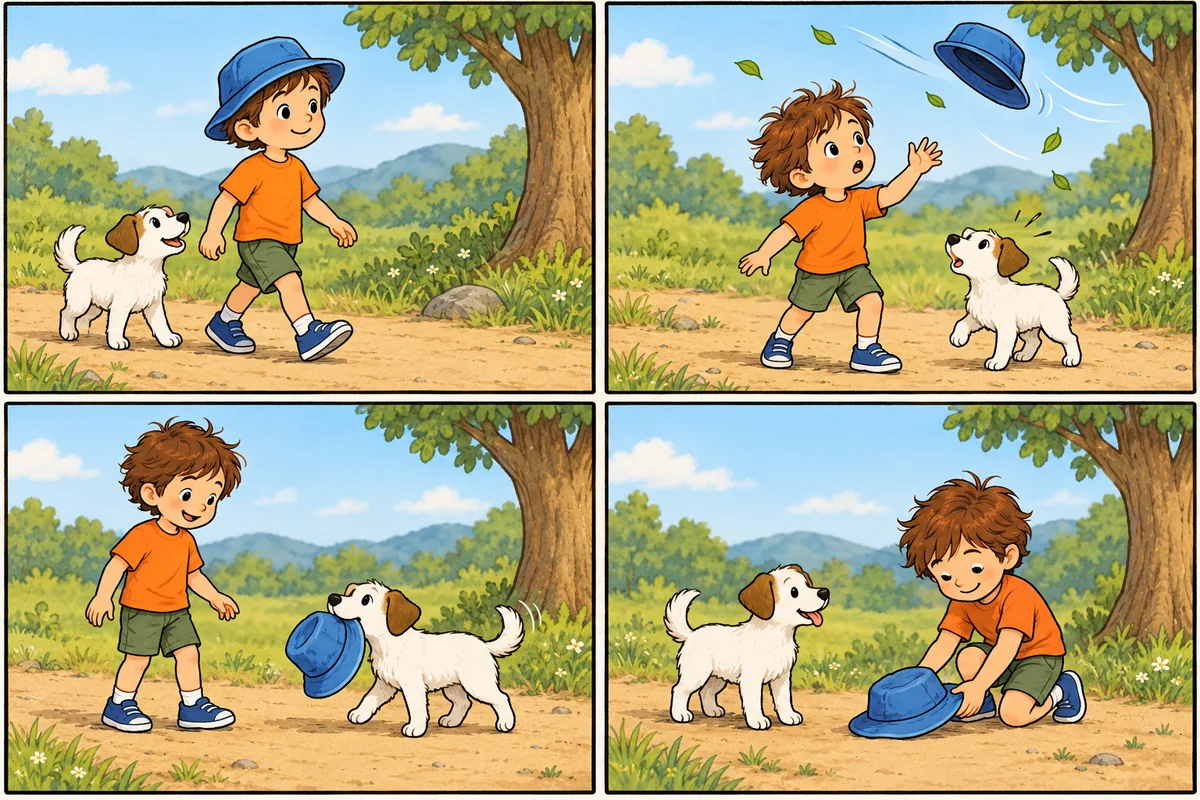
You can make a tiny original comic on scrap paper. Draw four boxes in a two-by-two grid:
- At the upper left, draw a child wearing a blue hat. Add a speech bubble: “Ready!”
- At the upper right, draw a gust blowing the hat away. Add a small caption: “Whoosh.”
- At the lower left, draw a dog catching the hat. Add the child’s bubble: “You found it!”
- At the lower right, draw the dog returning the hat. Add a bubble: “Thanks.”
Trace the route once: upper left, upper right, lower left, lower right. Show how the speech bubble points toward its speaker. Read the printed words yourself if your child wants help, and notice what changed between pictures.
Then let the homemade comic be a comic. Your child might add another panel where the dog wears the hat. There is no need to practice the route over and over when they would rather enjoy the joke.
How to choose a graphic novel for an early reader
Open the beginning, look at a scene in the middle, and check how the story ends. A colorful cover may contain scary images or humor you don’t want to share yet. A series name may be familiar while a particular installment takes a different turn.
For an early reader, useful questions include:
- Can we tell which panel comes next without a lot of searching?
- Are the lettering and bubbles comfortable to see?
- Who is this meant for, and what happens in the story?
- Will my child want adult help with the words or jokes?
Ask a librarian for a few examples with clear layouts and the kind of story your child likes. Describe the reading you plan to do: “We want one we can read together” is different from “He wants a short comic to try alone.”
If your child wants to read a speech bubble and gets stuck, supply the word or take over the line when they want you to. You can help with the layout while still carrying the read-aloud.
When your child only wants comics
A comic can share the basket with a picture book, a fact book, and a short chapter book. You can choose a different format for a different evening without ranking the choices.
If your child wants only one series for a while, read some of it yourself so you know what they enjoy. Is it the friendship, the slapstick, the animals, or the fast little episodes? That detail can guide a next recommendation in any format.
Offer another book as an additional possibility: “This one has a funny dog too.” Avoid making it the price of keeping the comic. Borrowing gives you an easy way to try something unfamiliar.
During a shared read, decide how much to perform. You can read the bubbles and briefly describe an important silent action. You don’t have to narrate every mark on the page. Give your child time to look when a picture is doing the work.
When the format feels familiar, step back from explaining it. The comic belongs in the basket because your child wants to explore its story. A little help with the page can make room for that enjoyment.
How Echo Storybooks fits in
Echo Storybooks isn’t a comic app. It’s another format to keep nearby: narrated picture books your child can listen to or read aloud.
Quick questions
Do graphic novels count as real reading?
Yes. Comics tell a story through pictures, words, and panel order, and the American Academy of Pediatrics includes comic books among children’s reading choices.
Are graphic novels easier than other books?
Not always. Small type, crowded panels, and complicated jokes can make one harder than it looks, so preview the actual book.
How do I teach my child to follow the panels?
Pick an uncluttered page and trace the route once, usually left to right and then down a row. Check the page first, because layouts vary.
Try it with your child
One more format for the basket.
100+ original picture books, no ads. Get started free.