 Echo Storybooks
A guide for families
How to Share a Wordless Picture Book
A book with no printed story can leave you wondering where to begin. You don’t need a polished narration. You can look together, notice one thing, and see where the pictures take you.
The short answer
Start by looking through the pictures without narrating every page. Then offer one observation or possible story. Your child can talk, point, or keep looking. When the pictures leave something open, more than one imagined explanation may fit.
Start by looking, not narrating
Open to the first picture and give it a little time. You might notice a red mitten, a crooked window, or a character looking over a shoulder. Say the detail that actually interests you: “That mitten is all by itself.” Then turn the page when you are both ready.
The American Academy of Pediatrics suggests lingering over illustrations and using their details to start conversation. A wordless book gives you plenty of room for that kind of looking.
You can take a silent first pass. On the second pass, you may already know which character to follow or which small detail changes. Some books have a clear sequence of events; others leave more room to imagine. Explore the book you have instead of expecting every wordless book to work the same way.
If your child turns ahead, look at where they landed. You can return to an earlier page later. There is no script to lose your place in.
Try a three-picture story
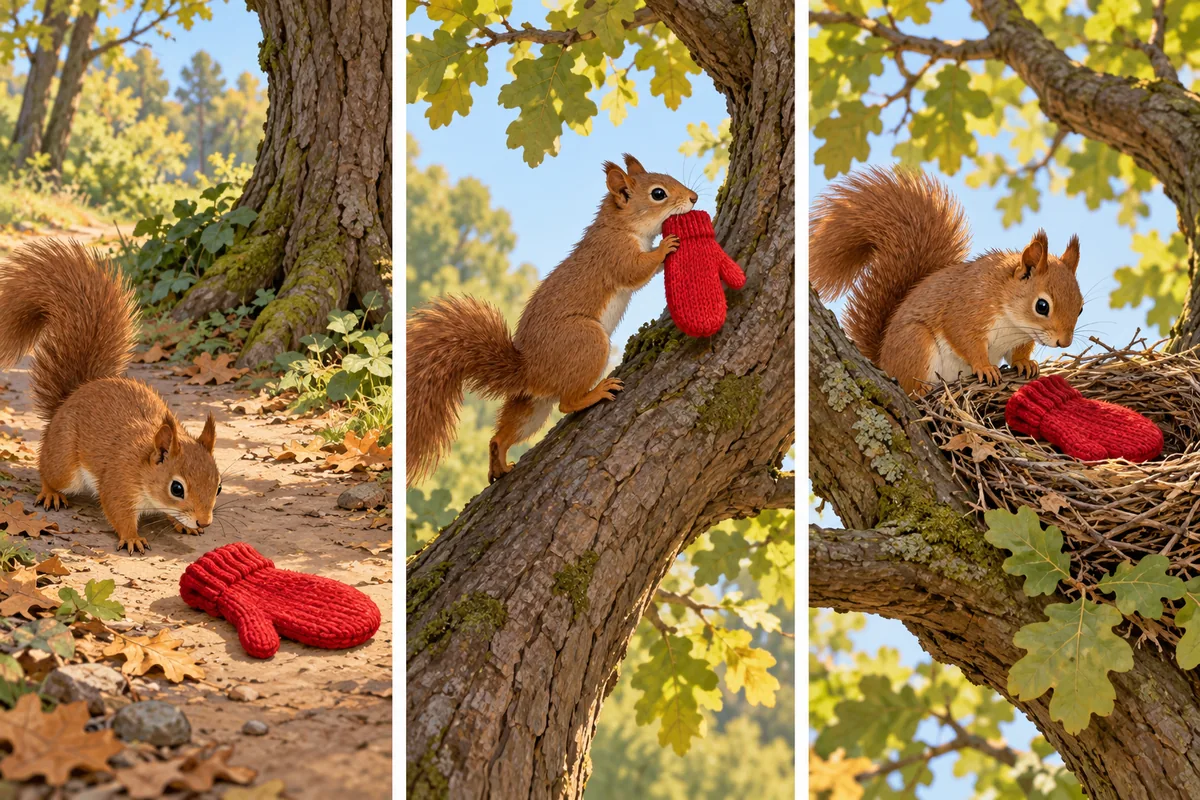
Imagine three simple pictures you could draw on separate pieces of paper. In the first, a red mitten lies on a path beside a tree. In the second, a squirrel carries it toward a branch. In the third, the mitten rests beside a nest while the squirrel looks down at it.
You could tell one possible story: “The squirrel found something soft. It carried the mitten up the tree and wondered whether it would make a pillow.” Another possible story is: “The squirrel thought the mitten might be a little bag of snacks. It carried the bag home, but there was nothing inside.” Those motives are invented; the pictures only show the finding, carrying, and arrival.
Let your child choose a possibility, add a different one, or point to a favorite picture. You can say, “You think it’s a sleeping bag. Let’s look at the last picture again.” A child who prefers to watch can simply watch.
Move the three pictures into a different order if everyone wants to play. What changes if the mitten is beside the nest first? That is a new pretend version you are making together, separate from following an author’s original page order.
What to say: comments work better than questions
A few comments can keep you company without making your child responsible for supplying the story. “The door is open now.” “I didn’t see that little dog before.” “She looks surprised to me.” Each gives your child something they may want to answer.
When you do ask, choose a question you are genuinely curious about: “Where do you think the squirrel is going?” Then allow time. If there is no reply, offer your own possibility or turn the page. Don’t keep rephrasing until the child produces an answer.
Pointing can be a useful way to join. If your child points to a moon, follow the gesture: “You found the moon. It’s getting dark in this picture.” You don’t have to ask them to name it before responding.
When the book clearly shows an action, you can describe it plainly. When a motive is unclear, use words such as “maybe,” “I wonder,” or “in our version.” That keeps an observation separate from an invention.
If two ideas conflict, look again together. “I thought that was a bag, and you think it’s a hat. Let’s see the next picture.” The shared looking can be interesting on its own.
How long should a wordless book take?
You may finish the entire book, spend the whole sitting on one detailed spread, or close it after a few pages. Choose the pace that makes looking possible. You don’t need to create a sentence for every object before moving on.
Another day, you can follow a background character instead of the main one. You might notice an animal you missed, give the characters names, or tell the same events in a different voice. Let that be an invitation rather than a required second activity.
If your child wants a conventional read-aloud, choose a book with words. A wordless book is one format in the pile, and neither of you has to prefer it. You may enjoy it more on a day when you have time to look slowly.
For a caregiver who feels unsure, start with the smallest possible contribution: one thing you see and one possibility you imagine. “The mitten is on the path. Maybe someone will find it.” That is already enough to begin.
How Echo Storybooks fits in
Echo Storybooks stories do have words, but the pictures carry a lot. After listening, pick one picture and talk about it, the way you would with a wordless book.
Quick questions
How do you read a wordless picture book?
Look through the pictures first without narrating. Then offer one thing you notice or one possible story, and let your child talk, point, or keep looking.
What if my child and I see different stories?
That’s fine. When the pictures leave something open, more than one explanation can fit. Look again together.
Do we have to finish the book?
No. You might spend the whole time on one spread. Stop when the looking is done.
Try it with your child
Stories with pictures worth a second look.
100+ original picture books, no ads. Get started free.