Keeping Japanese alive at home is easier when stories do some of the work. Reading the same story in both languages is one of the simplest routines to try.
By the Echo Storybooks team · Updated October 3, 2026
The short answer
Read the same story in both languages. A familiar story gives you a starting point: revisit the pictures and listen to the words in the other language. Keep it short, regular, and playful; the goal is a good time with Japanese, not a test.
Which language first?
There is no single right order. Try one of these and keep what works for your family:
Stronger language firstHear the story in the language your child understands best, then enjoy it again in the other.
Same book, two daysEnglish today, Japanese tomorrow. The second day feels like a reunion with a favorite story.
One page eachSwitch languages page by page for a playful, game-like read.
Child’s choiceLet your child pick the language. You can offer a choice without pushing for one language.
One scene, two languages
Here is the same moment from The Button Trail (『ボタンの みち』) in English and Japanese.
English The words light up as the story is read.日本語 The same scene in Japanese.
English
Crow carried a pouch full of buttons.
One rolled out through a tiny hole.
More buttons dotted the path behind him.
日本語
からすは、ボタンの ふくろを はこんでいた。
ふくろの すみから、ひとつ ころん。
あるくたび、ボタンが ぽつり ぽつり。
Notice the sound words: ころん (a small roll) and ぽつり ぽつり (one by one). Japanese picture books are full of these, and children often love repeating them.
Keeping Japanese low-pressure
Let answers come in either language. If you ask in Japanese and your child answers in English, respond warmly and keep going.
Model, don’t correct. Repeat the phrase naturally in Japanese instead of asking your child to say it again.
Repeat favorites. Revisit a story your child enjoys and listen for a familiar word or phrase.
Keep the text simple. Japanese picture books for young children are usually written in hiragana with spaces between phrases, which is easier to follow along with.
Learning two languages is common, and mixing them is a normal part of bilingual development (ASHA: Learning More Than One Language). If you have questions about your child’s speech or language, talk with your pediatrician or a speech-language pathologist.
How Echo Storybooks helps bilingual families
Every story in both languagesAll 100+ original picture books have an English and a Japanese edition with the same pictures.
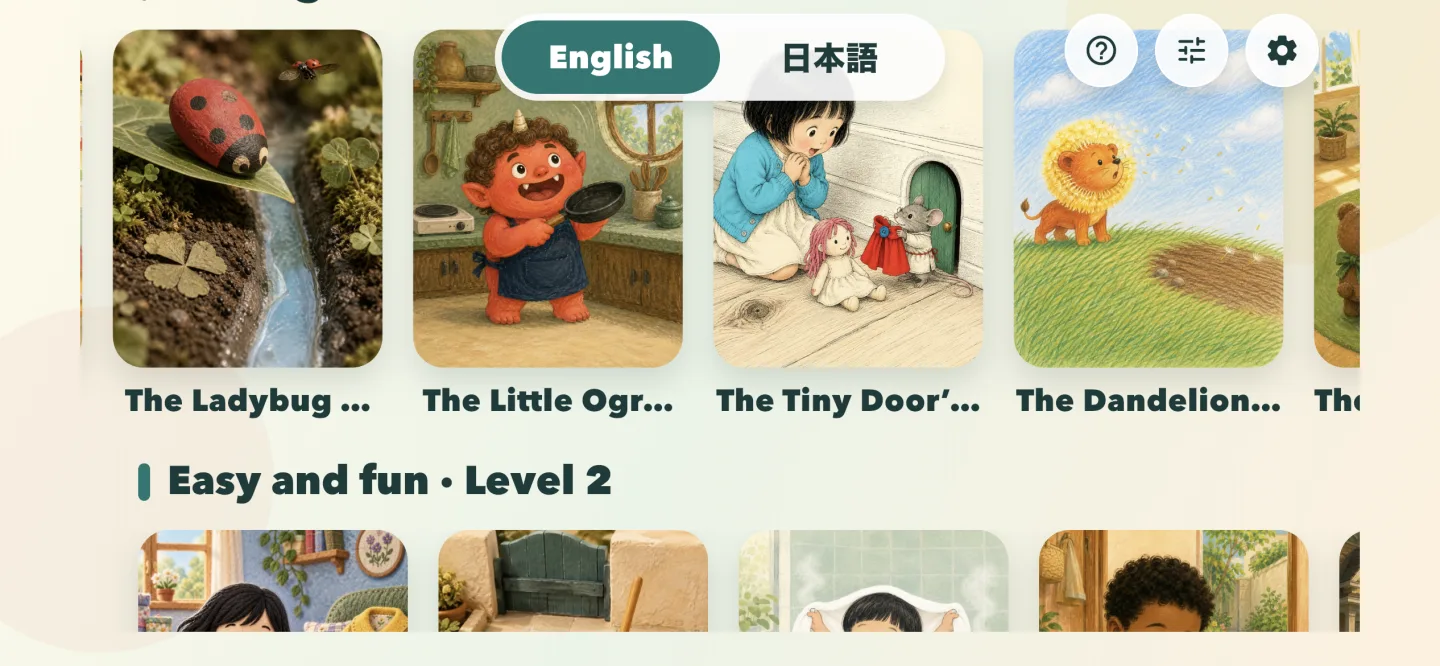
Switch in one tapChange the story language from the library whenever you like.
Separate levelsEnglish and Japanese each have Levels 1–6, so each language can move at its own pace.
Read aloud in bothYour child can listen, then read each line aloud in either language. Speaking is always optional.
The English / 日本語 switch sits at the top of the library.
Download for free, listen to stories, and give reading aloud a try.
Quick questions
Will hearing two languages confuse my child?
Many children around the world grow up with two or more languages. Mixing languages is a normal part of the process. If you have specific concerns about speech or language, ask your pediatrician or a speech-language pathologist.
Does my child need to read Japanese?
No. Children can listen to the Japanese narration and follow the pictures. Reading the text is optional.
I don’t speak Japanese. Can we still use Japanese stories?
Yes. The narration models the Japanese for you, and the same story in English makes it easy to know what is happening.
For English–Japanese families
Every story, in both languages.
Download for free, listen to stories, and give reading aloud a try. No ads, no account.
 Echo Storybooks