 Echo Storybooks
A guide for families
Storytime for Wiggly Kids: Reading While They Move
You open a book. Your child hops off the couch, stretches across the rug, and comes back to look at one picture. Storytime can make room for that kind of company.
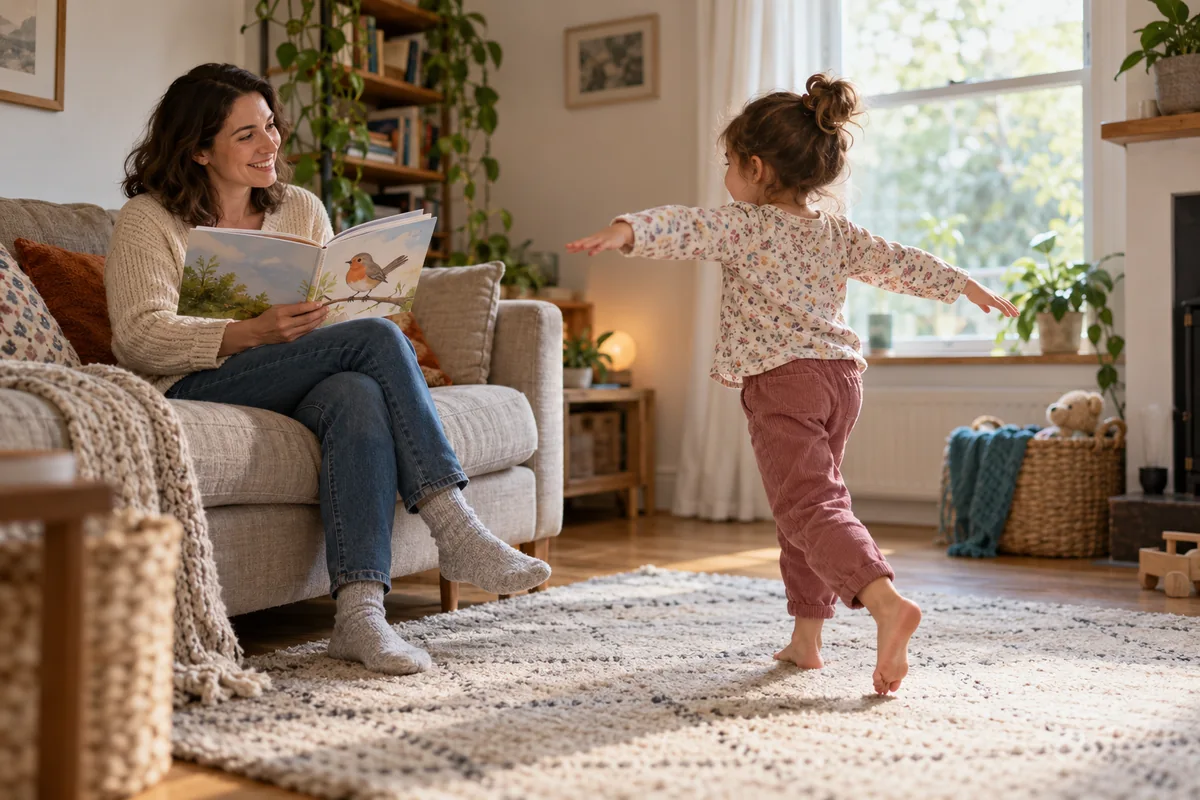
Try reading where your child can safely sit, stand, or move nearby. Offer one simple action connected to the story, and stop when sharing the book stops being enjoyable. Sitting in your lap is optional.
Look for company, not a perfect sitting pose
Start with a smaller question than “How do I get my child to sit through a book?” Ask, “Is there a way we can enjoy this page together?” A child may point from the floor, return for a funny picture, or make the sound of the animal you just read about. You can respond to those moments without asking for a different body position first.
In its guidance on reading with infants and toddlers, NAEYC describes children listening from a few feet away and using actions or props during a story. It also allows for stopping before the last page.
If your child says, “That bird has my shoes,” you can laugh and look at the bird. If they say nothing, you can keep reading for a little while and see whether the two of you still want to be there.
Give movement a safe place
Choose a spot where you can see your child and they can see the book when they want to. A clear rug beside the couch is simpler than a route around a coffee table. Move trip hazards out of the way and keep jumping off furniture out of the plan. You can hold the book; your child does not need to walk while carrying it.
Offer just one of these choices at first:
- Beside me: sit or stretch next to the reader, with room to change position.
- On this spot: stand on a small rug and sway or make a quiet gesture.
- Like the character: take a few slow steps within the clear space, then come back for the picture.
Three choices at once may become a whole new game. Pick the one that seems easiest today: “You can stand on the rug while I read.” The boundary is about safety and making it possible to share the story. You can be clear about that without treating movement as misbehavior.
Try one action at one story moment
Suppose a bird in the story opens its wings. You might say, “Here come the wings,” and open your arms once. Your child can copy you, watch, or do something else. Then continue reading. You do not need a movement for every sentence.
A quiet action is often easier to fit into the story than a big one. A mouse can take tiny steps. A tree can reach up. A turtle can pull its head into its shoulders. Leave running, climbing, and games that need your full attention for another time.
If the action takes over, acknowledge the fun and choose what happens next: “The bird game is getting big. Let’s put the book here and play.” Or offer a reset: “I’m going to read this last page. You can look from the rug.” Neither choice requires calling the activity a failed storytime.
For a child who wants something in their hands, try one familiar soft toy. Let it listen beside them. A pile of toys, a costume change, and a pretend obstacle course may be more preparation than the afternoon needs.
End while you still want to try again
Movement alone does not need to end the reading. But you can stop when you are mostly repeating instructions, protecting the book, or trying to read over another game. A simple closing line is enough: “We’re putting this story here. We can come back to the fox later.” Place a bookmark if you want to keep your place.
Next time, change one thing rather than rebuilding the whole routine. Try after outdoor play instead of before it, a shorter book instead of the longer one, or a floor cushion instead of a lap.
For a narrated option, try one short English story in Echo Storybooks together. The words are highlighted as the narration plays, and speaking is optional. Keep the same safe-space plan you would use with a paper book.
Afterward, notice what actually worked: your child came over for the picture, you both enjoyed the animal sound, or you stopped without a battle. That gives you something specific to try again. You can share a story without asking your child to hold one pose for its entire length.