 Echo Storybooks
A guide for families
You Don’t Need Funny Voices to Read a Good Story
You open a book, reach the first line of dialogue, and wonder whether the rabbit needs a special voice. It doesn’t. You can enjoy the whole story together without sounding like an audiobook narrator.
The short answer
Read in a comfortable version of your usual voice. A pause before a surprise, a clear change between speakers, or one small sound can add interest. Character voices are optional.
Start with the voice you already have
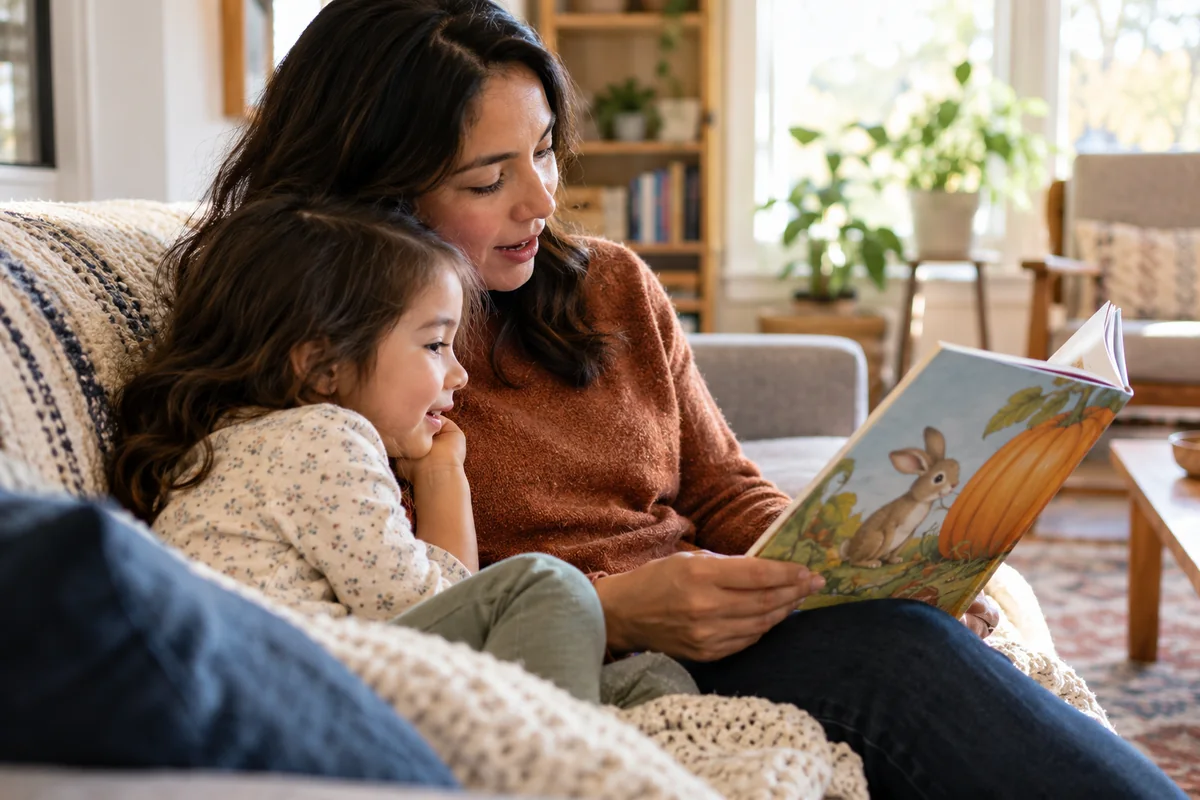
A book can bring plenty of action to the couch on its own. There are pictures to inspect, a problem to follow, and a page to turn. You can share those things in the same voice you use to tell your child about the day.
Try reading the opening paragraph as though you were telling someone what happened on your walk. Let sentences end. Take a breath when you need one. If you normally speak softly, you can keep that softness; if you sound cheerful and brisk, you don’t need to become solemn because a book is open.
The American Academy of Pediatrics offers several ways to enjoy books together, including looking closely at pictures and talking about them. Those give you other places to find the fun when character voices aren’t your thing. See its playful reading suggestions.
You can also tell your child up front, “I’m reading this one in my regular voice.” Then settle in and begin.
One tiny scene, three ways to read it
Here’s an original practice scene: Rabbit knocked on Bear’s door. “I brought you something small,” Rabbit said. Bear looked outside. “That’s a very big pumpkin.”
Choose whichever version sounds comfortable. You don’t have to try all three with your child.
- Plain: Read the whole scene in your normal voice. The mismatch between “small” and the big pumpkin supplies the joke.
- With a pause: Read Rabbit’s line, then leave a little space before Bear sees the pumpkin. Give your child a moment to imagine the giant pumpkin.
- With one sound: Add a gentle “knock, knock” before Rabbit speaks. Keep both characters’ dialogue in your own voice.
None of these versions needs a squeaky rabbit, a booming bear, or an accent. If you stumble over the words, just restart the sentence. The pumpkin will still be funny.
In a real picture book, you can put the pause before turning the page rather than adding anything to the printed story. If your child is already reaching for the next page, go ahead and turn it.
Help the listener follow who’s talking
Two speakers don’t always need two voices. Often the words “Rabbit said” and “Bear asked” do the work for you. Give those words the same care as the dialogue instead of racing past them.
When a page has several short exchanges, leave a small breath between turns. You might look toward one side of the picture for Rabbit and the other for Bear. Or briefly point at the speaker, provided that pointing doesn’t block the picture your child wants to see.
A question can sound like a question in your everyday voice. A quiet line can be a little quieter. These are small choices you already make in conversation. A little change in pace can carry you from one speaker to the next.
If your child asks who said something, answer directly: “Bear said that part.” Repeating the line is more useful than trying to rescue the scene with a sudden dramatic performance.
What if your child asks for the funny voice?
You can agree, negotiate, or pass. “I can do the knock, but you’ll have to do the giant’s voice” invites a willing child into the joke. “I’ll do the duck once” puts a manageable limit on a sound you find tiring.
If you’d rather skip it, try, “Today I’m using my own voice. You can imagine what the duck sounds like.” Keep reading without turning that decision into a long conversation about your abilities.
When your child supplies a voice, follow their version if you like. A dragon that sounds like a kitten doesn’t need correcting. When they simply listen, let that be enough too.
For an occasional change of reader, you can listen to an Echo Storybooks story together and watch the highlighting. Then return to your own reading whenever you want. Hearing another narration doesn’t set a standard you have to match. The next time you pick up a book, your familiar voice is ready.
Try it with your child
Listen to a story together.
100+ original picture books, no ads. Get started free.