 Echo Storybooks
A guide for families
Let Your Child Invent a Different Story Ending
Your child closes a familiar book and says the fox should have done something else. That’s a good opening for a new story. You can keep the book’s ending and make room for their version too.
The short answer
Finish the original story, then invite one small change: a different destination, a new use for an object, or another character’s choice. Your child can invent the ending with words, a drawing, or a toy.
Read the book’s ending first
Start after the last page. “That’s how this book ends. Want to make up another ending?” keeps two things clear: the author wrote one story, and your family is free to invent another.
You don’t have to make the new version more sensible, more cheerful, or more educational. A picnic can finish with everyone flying home on a pancake. If your child loves the original ending and doesn’t want to change it, choose a made-up starting scene instead.
The American Academy of Pediatrics includes inventing a different ending among its playful reading ideas. Start with the part your child wants to change and see where their idea goes.
Keep a favorite story intact when that matters to your child. You could say, “The rabbit still gets home in the original book. Our rabbit is taking a different road today.”
Try the fox and the lost hat
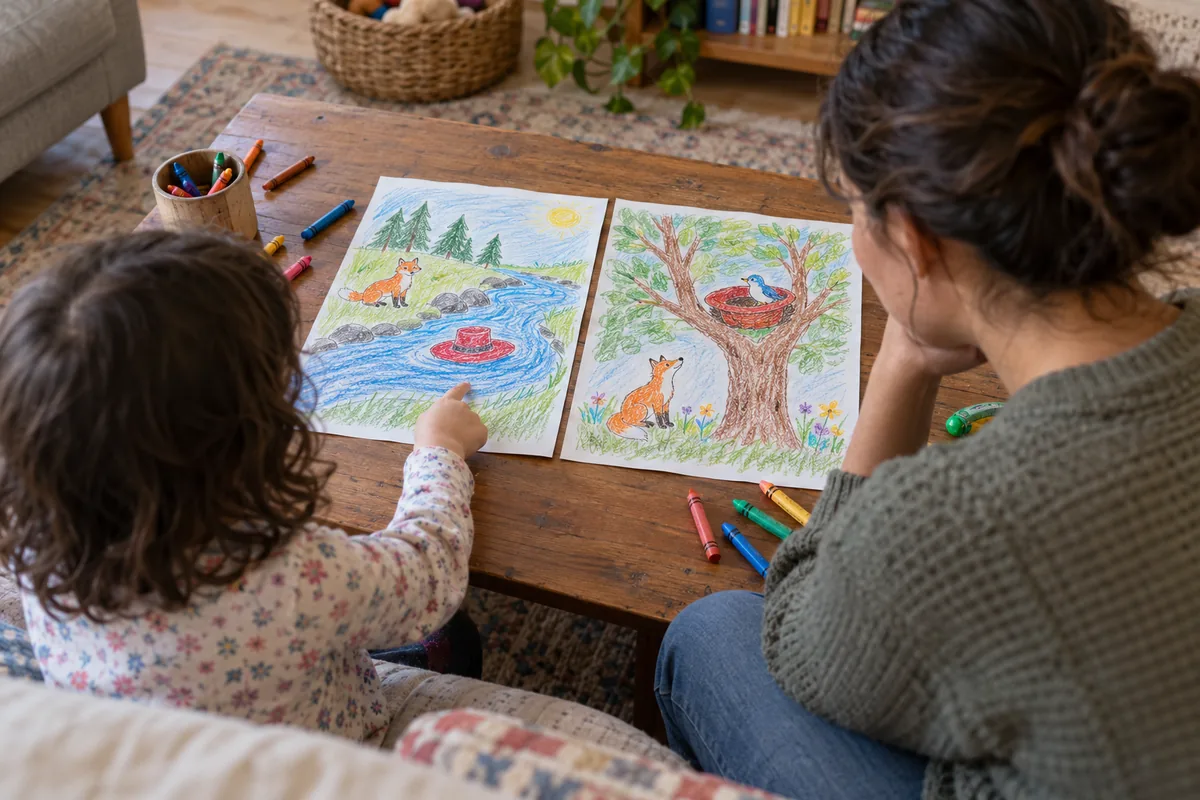
Here’s an original scene you can use right away: A fox finds a red hat beside a stream. He asks a duck, a bird, and a sleepy bear whether it belongs to them. Nobody knows. In the first ending, the fox hangs it on a branch so its owner can find it.
Now change just the hat’s destination. Maybe the fox puts it in the water, where it becomes a boat for a very small passenger. You can decide who climbs aboard: a mouse, a beetle, or a tiny fox with a suitcase.
For a different ending, the bird carries the hat to a tree and makes a cozy nest. What happens when the owner comes back? Perhaps they look up, see the nest, and decide to wear a scarf instead.
Both versions start with the same lost hat. That shared starting point saves you from inventing a whole world while your child waits. If they immediately suggest a third ending, let that one take over.
Use one small prompt
A big request like “Make up an ending” can leave everyone staring at each other. Pick one of these smaller invitations instead:
- Change the place: “What if the hat ended up on the moon?”
- Change the use: “Could the hat be something besides a hat?”
- Change who arrives: “Who might come looking for it?”
- Change one choice: “What if the fox kept walking?”
Choose one prompt and give it some room. You can offer your own idea first: “I think the hat could be a soup bowl.” Your child might agree, reject it, or turn the bowl into a swimming pool.
A silly idea doesn’t need a lesson attached. If you notice yourself steering every version toward sharing or kindness, try letting this one remain a hat-shaped spaceship. You can enjoy the child’s choice without explaining what it teaches.
Let your child draw or act out the ending
Set out one sheet of paper and ask, “Where does the hat go in your picture?” A red scribble beside a blue line may be the entire boat scene. Let your child describe it if they want; don’t require labels or a complete sentence.
With toys, a cup can stand in for the hat and a stuffed animal for the fox. Your child can move the cup into a pretend river while you supply a sentence: “The fox pushed the hat-boat away from the bank.” Watch whether that fits their idea before adding more.
If they point upward, you might ask, “Up in the tree?” A nod gives you enough to continue. If they shake their head, wait for another clue rather than filling the whole story for them.
You don’t have to finish a whole new book
Some endings arrive as one line: “Then the hat exploded into flowers.” That can be the end. You don’t need to ask what happened next until the idea becomes a polished plot.
If your child wants to keep their drawing, write down the ending in their words, with their agreement, and tuck it somewhere they can find it. If they don’t, let it be a story that existed for a few minutes.
You can return to the fox scene another day and find the hat somewhere completely different. Start at the stream, let your child choose its destination, and see which ending arrives this time.
How Echo Storybooks fits in
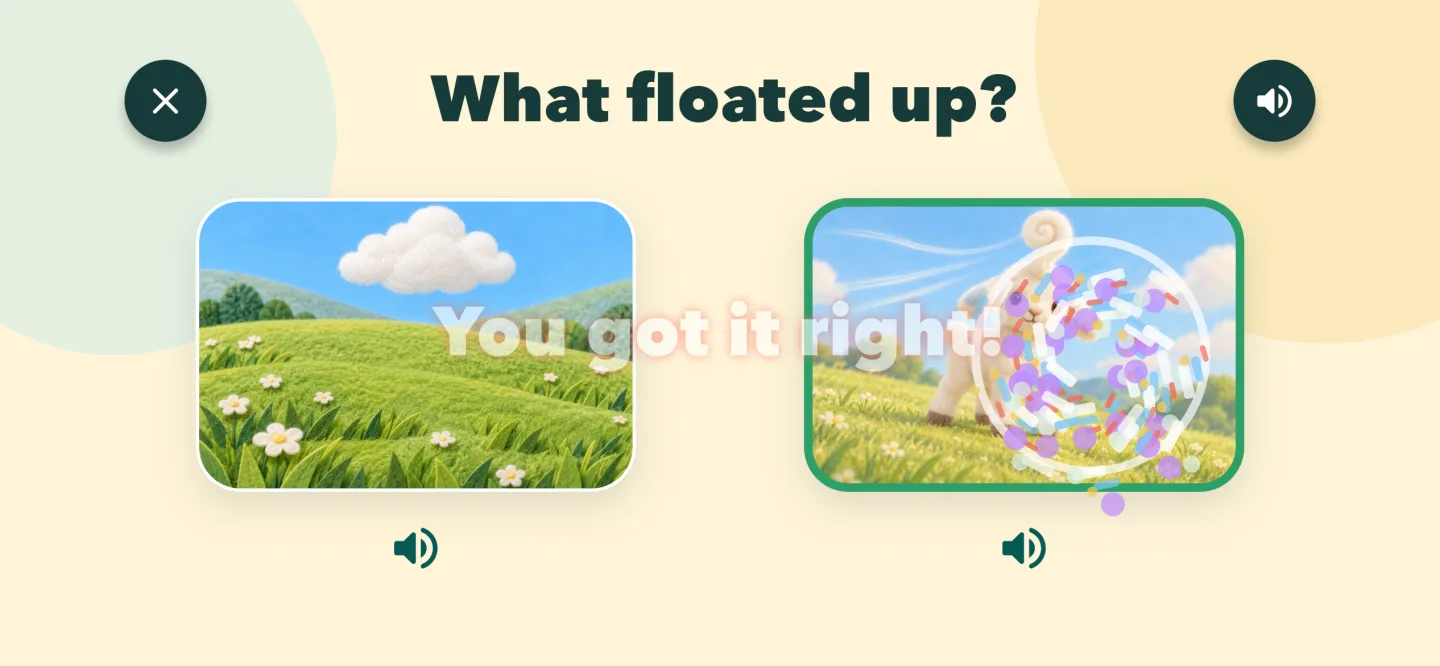
Finish an Echo Storybooks story first. The picture question at the end is an easy place to ask, “What if it went differently?”
Quick questions
How do I help my child make up a different ending?
Finish the original story, then change one small thing: where an object ends up, what it is used for, or what another character chooses.
What if my child can’t think of anything?
Give one small prompt instead of “Make up an ending.” For example: “What if the hat ended up on the moon?”
Does the new ending have to be told in words?
No. A drawing, a pointed finger, or a toy acting it out all count.
Try it with your child
A story to finish, then reinvent.
100+ original picture books, no ads. Get started free.