 Echo Storybooks
A guide for families
Halloween Stories for Kids Who Prefer Gentle Spooky Fun
A child can love costumes and pumpkins while wanting nothing to do with a shadowy monster. Halloween books come in many tones, and the cover alone does not tell you what is inside.
Preview the entire story, including the illustrations and ending. Start with the kind of Halloween fun your child already enjoys, such as silly costumes or pumpkins, and offer a clear choice to stop. Gentle spooky fun does not need to become a test of bravery.
Find out what “spooky” means to your child
Some children enjoy a friendly ghost but dislike a loud surprise. Others are happy with a mystery sound until the picture shows a dark room. Start with something specific: “Would you like a funny pumpkin story, or a story about costumes?” That gives you more useful information than asking whether they like scary books.
Look back at a picture they enjoyed. Was it the silly expression, the familiar setting, or knowing what made the noise? Use that detail to choose the next book. A story described as gentle by another family may still contain the one image your child would rather avoid.
In its Halloween guidance for babies and toddlers, the American Academy of Pediatrics suggests books as a way to talk about the holiday and says it is okay for a young child not to participate. The selection ideas here are about finding a story your family wants to share.
Use three tones to describe the book
These made-up examples show three different kinds of content, so you can describe what a book actually contains and choose a suitable tone.
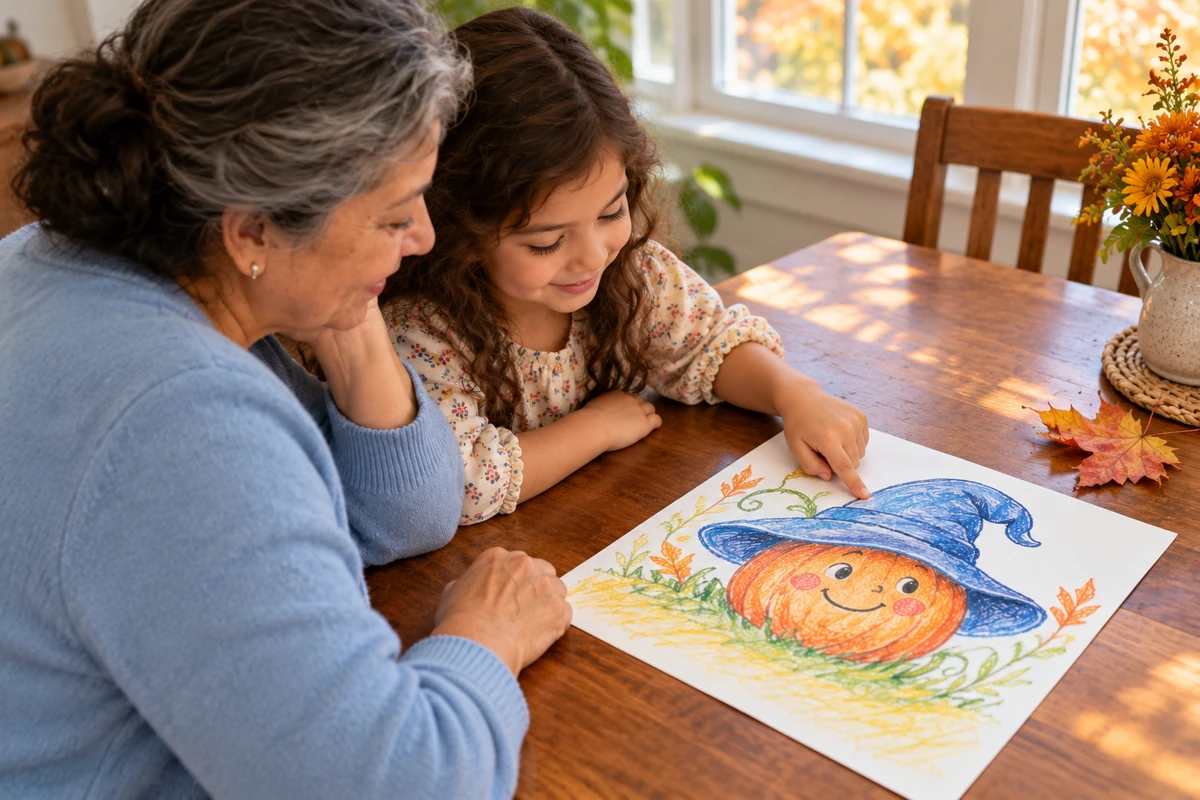
- Silly autumn: A pumpkin wears a floppy hat that keeps falling over its eyes. The joke is visible from the start. No one is hiding, chasing, or threatening anyone.
- A friendly mystery: Something rustles behind a basket of leaves. The characters wonder what it is, then find a kitten playing with a leaf. There is a brief unknown, with an ordinary explanation.
- A threatening scene: A creature follows a character through a dark house. Even if the ending is funny, the story spends time on pursuit and danger. You may decide this book is a poor fit.
Describe the actual book just as plainly: “There is a noise, and the next page shows what made it.” Or, “This one has a character being chased. Let's choose the pumpkin book instead.” You can reveal an ending before reading if your child wants to know it.
Check more than the final happy page
Flip through the whole book before sharing it. A friendly ending does not erase every image on the way there. If it is an audio or video story, preview the version you plan to play; music, voices, and sudden sounds can change the experience.
Use four questions to make the choice:
- What looks threatening? Notice teeth, looming shapes, chase scenes, and characters trapped or separated from their helpers.
- How long is the uncertainty? A sound explained on the next page is different from a mystery stretched through the entire story.
- What happens to the characters? Look for hurt, loss, or danger that the cheerful cover did not mention.
- Is the joke kind? Consider whether frightened characters are mocked or pressured to join in.
Then choose on your child's behalf where necessary, and offer a choice between suitable books. You do not need to show a frightening picture to find out whether they can handle it.
Make stopping easy
Before opening the book, try: “We can close it whenever you want.” Keep that promise if your child turns away or asks to stop. Put the book aside and offer an ordinary next activity, such as drawing a pumpkin's hat or reading a familiar non-Halloween book.
If your child asks what is real, answer the particular question. “That talking pumpkin is made up” is clearer than insisting the whole holiday cannot be scary. You can enjoy a fictional character while also choosing to walk past a decoration your child dislikes.
During a friendly mystery, you might pause to show the kitten early. If your child likes the surprise, keep the page turn. Let their preference shape how you share this story instead of protecting suspense at all costs.
Halloween can be mostly pumpkins
A family reading pile can contain orange leaves, funny hats, nighttime animal adventures, and very little that is frightening. A librarian can help you find that mix if you describe the elements you want to avoid. Ask for “no chasing or threatening monsters” rather than only “nothing too scary.”
There is no need to add a more intense story before October ends. If fear continues beyond particular books or decorations and is getting in the way of everyday activities, talk with an appropriate professional about the real concern. Choosing stories remains a small part of family life, with plenty of room for ordinary fun.